How to Unclog a Bathtub Drain
Learn how to unclog a bathtub drain using simple tools and safe methods. Many common bathtub clogs caused by hair and soap buildup can be removed in a few easy steps.

Learn what causes sewer backups, how to spot the warning signs, the difference between a drain clog and a main sewer problem, and which repair options offer a real long-term fix.
Summarize with
A sewer backup is one of the most stressful plumbing problems a homeowner can face. If sewage is coming back up through a basement drain, shower, toilet, or cleanout, you are dealing with more than a simple clog.
The good news is that sewer backups usually leave clues before they become full-scale disasters. The better news is that once you understand the real cause, you can choose a solution that fits both your home and your budget.
If wastewater or sewage is coming back up through showers, toilets, or the main cleanout on the lowest level of your home, you likely have a main sewer line backup.
If this is happening, stop using water immediately. Do not flush toilets, run sinks, use the dishwasher, or start the washing machine. Any additional water can make the backup worse.
A sewer backup happens when the flow of wastewater from your home to the municipal sewer line is interrupted by a clog, pipe damage, root intrusion, or another sewer line failure. Because wastewater cannot move forward, it reverses direction and comes back into the house through the lowest available drain.
Early signs are easy to miss. Slow drains, gurgling fixtures, or low-level drains backing up first can all point to a sewer line problem before a major event occurs.
A clogged drain and a clogged main sewer line are not the same thing.
A drain clog is usually isolated to one sink, tub, or shower. It affects that one fixture and is often caused by hair, soap scum, grease, or minor debris.
A main sewer line backup affects the entire home’s drainage system. When the main line is blocked, wastewater from multiple fixtures has nowhere to go and can back up into the basement or lowest plumbing fixtures.
That is why a clogged drain is usually an inconvenience, while a clogged main sewer line can quickly become a serious cleanup and repair problem.
There are three major causes of sewer backups in residential homes:
In many homes, the problem is actually a combination of these issues rather than just one.
What goes down your drains matters. Even if something seems to disappear without an immediate issue, it may still contribute to a clog over time.
Items that should never be flushed or poured down the drain include:
Many of these materials do not break down properly. Instead, they catch on rough pipe surfaces, root masses, or damaged joints and begin forming larger obstructions.
A fatberg is a mass of grease, oil, fat, and non-biodegradable material that builds up inside sewer lines. Wipes, hygiene products, and food debris often give the grease structure, creating a large blockage that can restrict or completely stop sewer flow.
That is why grease should never be poured down the drain, even when it is still warm and liquid.
Toilets are designed for only three things: pee, poo, and toilet paper. Following that rule helps reduce the risk of major sewer blockages later.
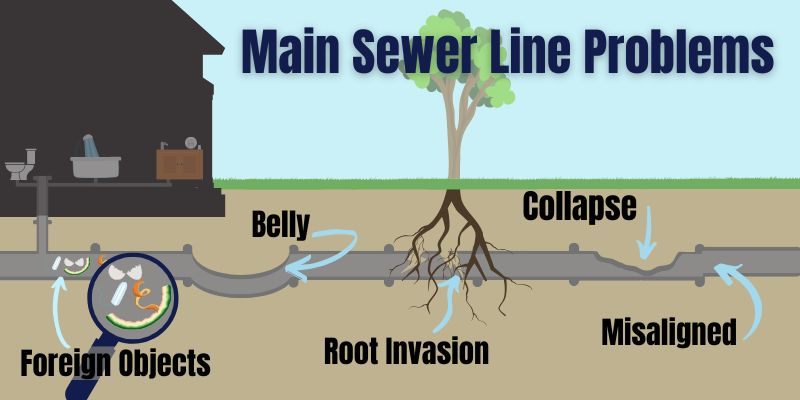
Many sewer backups happen because the sewer pipe itself is failing. Older lines can develop cracks, deteriorating joints, bellies, offsets, corrosion, and eventually collapse.
These problems may exist underground for years before the homeowner becomes aware of them.
Cracks are common in older sewer lines. When a pipe cracks, wastewater can leak out and soften the supporting soil around the pipe. Over time, that can lead to sagging, shifting, root intrusion, and additional structural damage.
A pipe belly is a low section in the sewer line where the pipe has sagged. Wastewater and solids collect in that low spot instead of flowing properly toward the city sewer line. As debris accumulates, a clog forms and the risk of backup increases.
Pipe misalignment, also called an offset joint, happens when sections of pipe no longer line up correctly. This can happen because joints weaken, roots push pipes out of place, or the supporting soil shifts. Once the pipe becomes offset, waste can catch at the joint and backups become much more likely.
Collapses usually happen in older sewer systems after years of deterioration, root damage, shifting, or unresolved misalignment. A collapsed sewer pipe is a major issue because it blocks the line and usually requires more extensive repair than a standard clog or minor crack.
The type of sewer pipe in your home often depends on when the home was built.
Tree roots are one of the most common causes of sewer backups, especially in older neighbourhoods with aging sewer lines.
Roots are naturally attracted to water, oxygen, and nutrients. If a pipe has even a tiny crack or leaking joint, small roots can enter and begin growing inside the sewer line. Over time, those roots become a root ball that acts like a net, catching toilet paper, debris, and waste until a blockage forms.
As roots continue to grow, they can also worsen pipe misalignment and cracking.
A sewer line camera inspection is one of the most valuable tools for diagnosing sewer problems. It can show whether the issue is a simple blockage, root intrusion, a belly, cracked pipe, offset joints, or collapse.
Without a camera inspection, homeowners often spend money on temporary clearing methods without ever addressing the real cause.
If you own an older home or have had even one sewer-related issue, an annual camera inspection is one of the best ways to reduce surprise backups.
Short-term clearing options can restore flow, but they usually do not fix the actual reason the backup happened.
Augering, also called snaking, is often the fastest way to break through a clog during an emergency. It can restore flow quickly and is useful when you need immediate relief.
However, augering is usually a temporary fix. It opens the blockage, but it does not repair root entry points, cracked pipes, bellies, or misalignment.
Hydro jetting uses high-pressure water to clean the inside of the sewer pipe. It can remove grease buildup, debris, and some root growth more thoroughly than an auger.
It is often a good maintenance option, but it is not always ideal during an active backup, especially if there is no suitable outside cleanout. Like augering, hydro jetting does not fix the damaged pipe that caused the problem.
Chemical root treatments can help slow root growth in the short term. They may be useful as a maintenance step in certain situations, but they are not a permanent fix. If the pipe still has a crack or leaking joint, roots will often return.
If you want to stop dealing with repeat backups, the long-term solution is usually to repair or replace the failing section of sewer line.
Pipelining, also called cured-in-place pipe lining, creates a new interior pipe within the old one using an epoxy liner. It can be an excellent solution for cracks, root intrusion, and leaking joints when the pipe still holds its overall shape and alignment.
One of the biggest advantages is that it often requires very little excavation.
Pipe bursting is a trenchless replacement method that breaks apart the old sewer pipe while pulling a new pipe into place. It can be a strong option when the old line is damaged or misshapen and a simple liner is no longer suitable.
This method can also be very helpful when the sewer line runs beneath a driveway, patio, or other structure you would prefer not to dig up extensively.
Traditional excavation and replacement may be the best option when the problem is isolated to a specific section or when the pipe has reached the end of its useful life.
In some cases, replacing only the damaged section is reasonable. In others, especially with very old sewer lines, full replacement makes more financial sense because more failures are likely to follow if only one section is repaired.
The right solution depends on the actual condition of the pipe, how deep it is buried, where the damage is located, and whether the line runs under structures or landscaping. That is why a camera inspection is the first step before deciding how to move forward.
Less expensive fixes may restore flow now, but they can cost more over time if the same sewer line keeps backing up again and again.
You can reduce the chances of another sewer backup by following a few simple rules:
Sewer backups are disgusting, stressful, and expensive, but they usually happen for understandable reasons. Once you know whether the cause is what is being flushed, failing pipes, or tree roots, you can make a smarter decision about whether a temporary clearing method or a permanent repair makes the most sense.
If you are dealing with recurring sewer issues or want to know the condition of your main line before a backup happens, The Gentlemen Pros can help with a professional plumbing inspection. For ongoing preventative maintenance, you can also learn more about our membership options.
TRENDING NEWS
Learn how to unclog a bathtub drain using simple tools and safe methods. Many common bathtub clogs caused by hair and soap buildup can be removed in a few easy steps.




Plumbing, heating & electrical service
2026 The Gentlemen Pros